What an eye exam actually looks for.
Beyond the chart on the wall — the quiet checks that catch glaucoma, diabetes, and brain conditions years before symptoms.
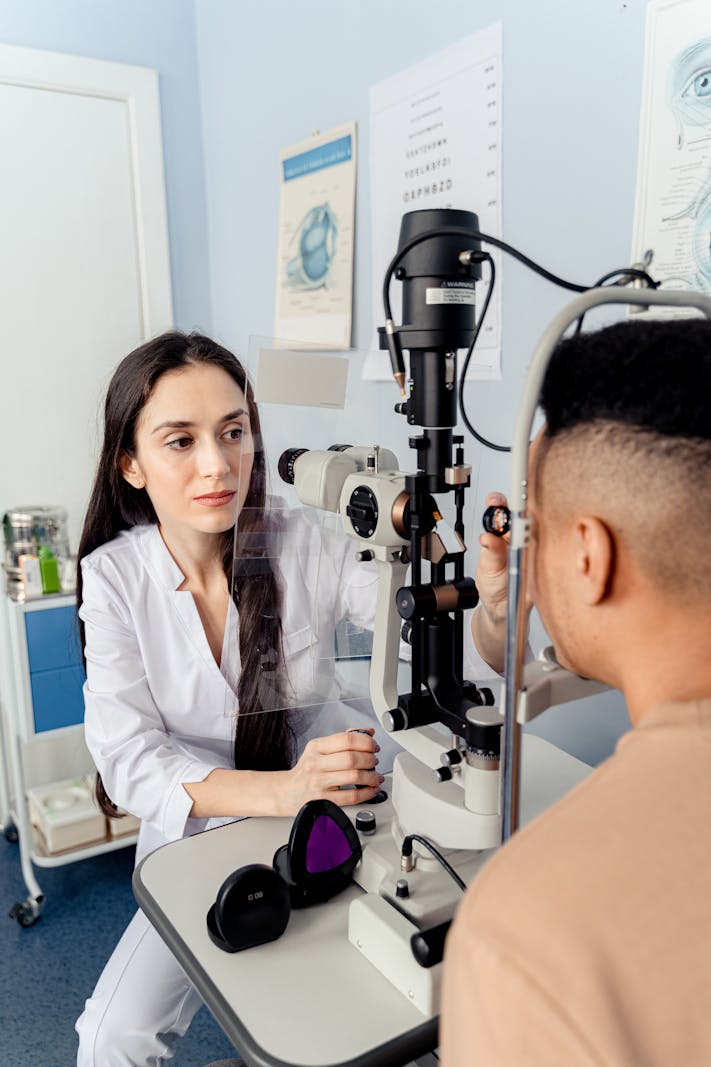
When most people picture an eye exam, they picture the chart on the wall — the row of letters that gets smaller as you go down. That part is real, and it matters. But it's a tiny slice of what we actually do while you're in the chair.
The chart is the warm-up.
A vision check tells us how well you can see right now. That's useful — it tells us whether your prescription needs adjusting. But it doesn't tell us what your eye is doing under the surface, or what might be quietly changing.
The exam that follows is, in many ways, a forty-minute physical for the most exposed nerve in your body. The optic nerve sits at the back of the eye and connects directly to the brain. We can see it without cutting anything open, and that makes the eye one of the most diagnostically useful organs in medicine.
What we actually check.
We measure the pressure inside each eye — too high, sustained over years, is glaucoma. We look at the blood vessels on the retina — leaks or new vessels there are often the first physical sign of diabetes or uncontrolled blood pressure. We check how the pupils respond, which can hint at problems further upstream, in the nerves or the brain itself.
We look at the lens of the eye for early clouding (cataract), the cornea for thinning or irregular shape (keratoconus), and the macula — the part responsible for sharp central vision — for the speckled drusen that precede macular degeneration.
Why frequency matters.
Most of these findings are slow. They don't announce themselves with pain or sudden vision loss. By the time a patient notices something is wrong, the underlying process is often years along. The point of an annual or biennial exam is to catch the slope of the change before the change becomes a symptom.
If you've been told for years that everything looks fine, that's the exam working. It's also the reason to come back next year.
Screens, strain, and the 20-20-20 rule.
Why your eyes feel raw after a workday — and the small habits that actually move the needle on digital eye strain.

Cataract surgery, demystified.
What changes when the cloudy lens comes out — recovery timelines, lens choices, and what "clear" looks like a week later.

Foods that quietly protect your vision.
Leafy greens, oily fish, a fistful of berries — what decades of retinal studies keep pointing back to, and what's hype.